

I Automated My Entire Social Media Strategy for 30 Days — Here's What Happened
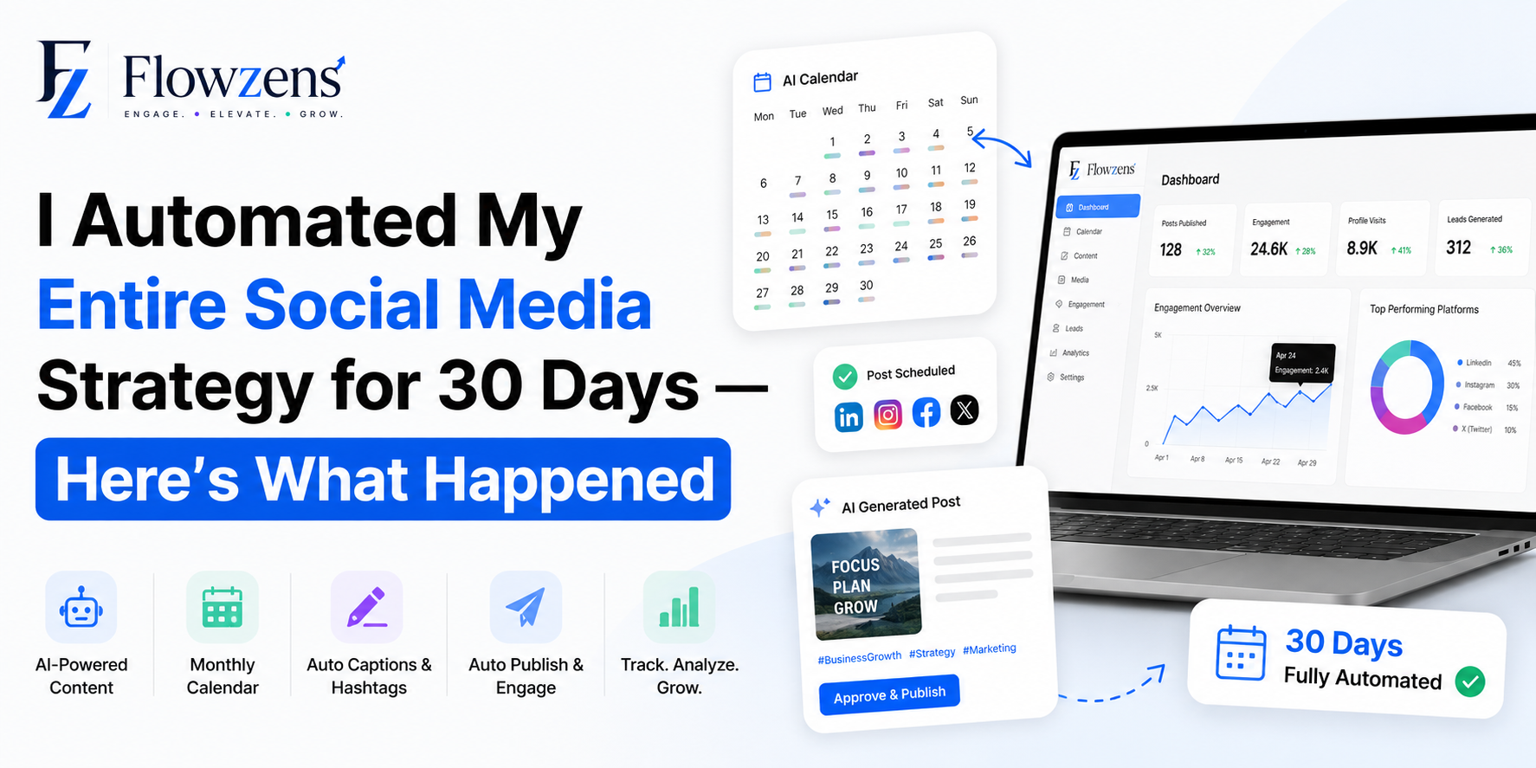
I stopped posting manually and handed my entire social media strategy to AI for 30 days. No freelancers, no scheduling spreadsheets, no 2am caption writing. Here is exactly what happened — the numbers, the surprises, and what I would do differently.
I want to be honest with you before this post starts.
I built Flowzens because I was drowning in social media work. As a founder, I was spending somewhere between 15 and 20 hours every month just on content — planning what to post, writing captions, resizing images, remembering to actually hit publish, and then feeling guilty on the weeks I did not. It was not sustainable. And I knew that if I was feeling this way, so were thousands of other business owners.
So when Flowzens was ready to use properly, I decided to run a real experiment. For 30 full days, I would hand my entire social media strategy — across LinkedIn, Instagram, Facebook, and Threads — over to the platform. No manually written captions. No freelancers. No scheduling spreadsheets. Just Flowzens, my brand profile, and a weekly 15-minute check-in to approve content.
This is what actually happened.
The Setup: What I Was Working With Before
Before the experiment, here is what my social media operation looked like honestly:
This is probably familiar to a lot of founders and small business owners reading this. You know you should be posting more. You just cannot make the time to do it properly.
Day 1 to Day 3: Setting Everything Up
I connected Flowzens to all four platforms — LinkedIn, Instagram, Facebook, and Threads — using secure OAuth. Took about four minutes total. No passwords entered anywhere, no credentials stored on my end.
Then I set up my Brand Intelligence Profile. I told the platform my industry, my target audience (founders, marketing managers, and agency owners), and my preferred tone — direct, founder-authentic, no corporate fluff. I set my posting frequency to five times per week across all platforms and let the AI Calendar Generator build out the full month.
What came back genuinely surprised me. A complete 30-day calendar with 22 planned posts, distributed across all four platforms, organized into content pillars — educational posts, product spotlights, engagement questions, and behind-the-scenes founder content. Each slot had a topic, a content angle, a recommended format, and a scheduled time.
I spent about 25 minutes reviewing the calendar, swapping two topics I did not like, and regenerating one slot that felt off-brand. Then I approved the batch and let it run.
Total setup time: under 45 minutes.
Week One: The Uncomfortable Part
I will be honest — the first week felt uncomfortable. Not because anything went wrong, but because nothing required my attention. Posts were going out. The approval inbox was filling with drafts that needed a single tap. I kept waiting for something to break.
The WhatsApp alerts were the part that made this feel real. Every time a new batch of drafts was ready, I got a notification on my phone. I would open the approval inbox, preview each post side-by-side across platforms, make minor edits if needed, and approve. The whole process took between 8 and 12 minutes per session, twice a week.
By the end of week one, 6 posts had gone live across LinkedIn, Instagram, Facebook, and Threads. That was already more than I would typically publish in an entire month.
One early observation: the LinkedIn captions were noticeably better than what I usually write myself. Proper white space, strong opening hooks, structured bullet points. I found myself approving them with almost no edits.
Week Two: The Numbers Start Moving
By the end of week two, something interesting was happening on LinkedIn. Three posts in a row had performed above my historical average. The engagement rate on those posts was sitting around 3.8% — more than three times my baseline.
I looked at what they had in common. All three were educational posts — specific, tactical advice aimed at founders dealing with marketing overhead. The AI had identified that this content pillar consistently outperforms product-focused posts for my audience profile, and it had weighted the calendar accordingly.
This is the part that is hard to replicate manually. When you are writing your own content, you tend to post what feels right in the moment. When a system is analyzing what actually performs and structuring your calendar around that signal, the output is more strategic than intuition alone.
Instagram was slower to move, which was expected. Organic Instagram growth takes longer. But post frequency had jumped from once a week to four times a week, which was already building the consistency the algorithm rewards.
Week Three: The Moment I Stopped Worrying
Something shifted in week three. I stopped checking whether posts had gone out. I stopped opening the analytics dashboard every morning. I just did my twice-weekly approval sessions and got back to work.
This sounds small. It is not.
Every founder I know carries a low-level background anxiety about social media. The sense that you should be doing more, posting more, engaging more. It sits in the back of your mind even when you are in the middle of a product meeting or a customer call. When Flowzens was running properly, that anxiety went quiet. The work was getting done. I did not have to think about it.
I also noticed something I did not expect: because the AI was handling the operational layer, the content I was approving was actually more considered than what I used to write reactively. I was reviewing strategy rather than scrambling to produce it.
Week Four: The Final Push and What the Data Said
By the end of 30 days, here is what the numbers looked like compared to the month before.
Posts published: 22 (up from 6 the previous month) LinkedIn engagement rate: 3.4% average (up from 1.2%) Instagram follower growth: +187 net new followers Facebook reach: Up 340% — mostly because I was actually posting there for the first time consistently Threads impressions: Up from near zero to 4,200 monthly impressions Time spent on social media content: Approximately 52 minutes total across the entire month — two approval sessions per week, roughly 10 minutes eachFor context, the month before I had spent an estimated 16 hours on social media content and published 6 posts. This month I spent under an hour and published 22.
What I Would Do Differently
A few honest lessons from the experiment:
Spend more time on the Brand Profile upfront. The quality of output is directly tied to how well you define your tone, audience, and content priorities at setup. I went a bit fast in the first session. By week two I had gone back and refined a few parameters, and the content quality visibly improved after that. Do not skip the approval step. The temptation once you trust the system is to approve everything in bulk without reviewing. Resist it. The 10-minute review sessions are where you catch the occasional post that is technically fine but slightly off-brand. The AI is very good. It is not perfect. Your judgment still matters. Use the analytics data. By week three I had real performance data showing exactly which content pillars were working. I used that to adjust the week four calendar focus manually. The system gives you information most people never act on — use it.The Honest Verdict
I went into this experiment as the person who built the product, so I was not exactly an unbiased test subject. But the results were more concrete than I expected, and the experience of running on autopilot for a full month taught me things about my own content strategy that 18 months of manual posting had not.
The three things that stuck with me:
First, consistency beats quality in the short run. Showing up five times a week with good content outperforms showing up once a week with great content. The algorithm rewards frequency. Your audience rewards familiarity.
Second, the time cost of manual social media is hidden. You do not feel the 16 hours because they are spread across a hundred small moments — the 20 minutes deciding what to post, the 45 minutes writing a caption and deleting it twice, the 10 minutes logging in and out of different accounts. When you see it as a single number, it is a shock.
Third, the strategic value of automation is not the content it produces — it is the headspace it returns. The hours I got back were not the most valuable part. The mental bandwidth was.
Try It for Yourself — Free for 14 Days
If any part of this experiment resonates with what you are dealing with in your own business, the best thing I can tell you is to test it yourself with your own brand, your own audience, and your own platforms.
Flowzens offers a 14-day full Premium trial with no credit card required. Connect your social channels, set up your Brand Profile, generate your first calendar, and see what 30 days on autopilot looks like for your business.If you are running an agency managing multiple client brands, the Elite Agency plan gives you 10 brand profiles, unlimited channels, and team seats — everything you need to scale delivery without scaling headcount.
Ready to Autopilot Your Growth?
Let Flowzens manage your social media pipeline. Scrape your site, map strategy, generate visual calendars, and publish natively on autopilot.